Viral AI Football Trends 2026: What Comes After Ozil
 Ozilai Team
How to spot the next viral AI football trend: the four ingredients that make a moment reusable, and how to judge a new one before the crowd does.
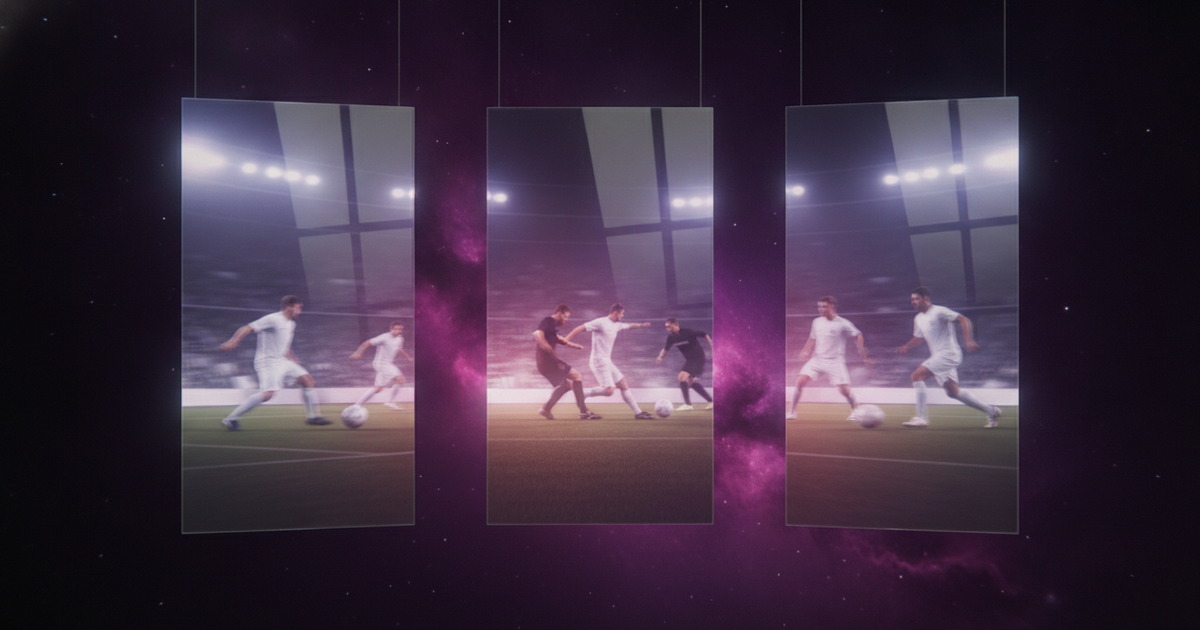
Football moments become AI trends when they can be reduced to a single action any face can perform. The Ozil goal is the current example, and the next one will look nothing like it while passing the same four tests: one recognisable action, a short duration, a clean silhouette, and a result any face can drop into. If a moment fails any one of those four, it will not survive contact with a general audience — no matter how famous the goal is. This guide explains the mechanism, scores the current trend against it, and gives you a method for judging a new moment before it peaks.
Gere o seu aqui
Escolha uma foto clara e bem iluminada da pessoa a quem o gol pertence.
Carregue uma foto para continuar.
Ao gerar, você confirma que tem permissão para usar esta foto.
Seu clipe aparece aqui
Uma renderização com as configurações padrão custa 30 créditos.
Why Football Moments Beat Other AI Trend Templates
Football is a visual language almost everyone already reads. A goal needs no dialogue, no caption, and no translation to be understood; the drama lives in the movement. That makes it unusually well suited to AI video, where the model has no script to follow and only pixels to animate.
There is a second reason, and it is the one people miss. A great goal is already choreographed. Somebody decided the exact sequence of runs, the angle of the chip, the moment the defenders slide. When you build an AI trend on top of that, you inherit that direction for free — the reference footage exists, the audience remembers it, and the model has a shape to follow. Trends built from nothing fight the model; trends built on a remembered moment let the model coast.
The Four Ingredients Every Reusable Trend Shares
A football moment does not become a template because it is famous. Plenty of famous goals are impossible to reuse. What makes a moment reusable is whether a normal person's face can be dropped into it and still work — and that comes down to four ingredients.
One recognisable action
The moment has to collapse to a single action a viewer can name in three words: a chip, a volley, a slide. If it takes a whole sentence to explain, the audience cannot recognise the homage, and recognition is the entire engine of a trend. The cleaner the single action, the more faces it can wear.
A short duration
AI clips that hold together run short — a handful of seconds, not a highlight reel. A moment that lives in a tight window fits that constraint naturally; a moment that needs half a minute of build-up does not, and trimming it usually kills the drama that made it worth copying in the first place.
A clear silhouette
Think about what the shot looks like as a shape, not as detail. A lone striker against a goalkeeper is a strong silhouette: two figures, one ball, an obvious geometry. A scramble in a crowded box is the opposite — bodies overlapping, no readable outline — and it makes both the model's job and the viewer's job harder.
A drop-in result
Finally, the result must be one any face can carry. If the moment's meaning depends on who scored it — a specific rivalry, a celebration tied to one person — swapping the face breaks the joke. The best templates are ones where the identity is incidental to the action and the action is the point.
Here is the same idea laid out so you can score a moment against it.
| Trend ingredient | Why it spreads | How to judge a new one | | ----------------------- | ---------------------------------------------------------------------------- | --------------------------------------------------------------------- | | One recognisable action | A viewer can name the homage in seconds, so no explanation is needed | Can you describe it in three words without naming the player? | | A short duration | Short clips hold together in AI generation and fit short-form players | Does the moment land in a few seconds with its meaning intact? | | A clear silhouette | Strong geometry reads instantly on a phone and gives the model a clean shape | Squint at it — are the figures and the ball still readable as shapes? | | A drop-in result | Any face can wear the action without breaking the joke | If you remove the original player's identity, does it still work? |
How the Ozil Goal Scores on All Four
The 2016 Arsenal chip is worth scoring against the table because it is the current template, and seeing why it passes explains how to read the next one.
- Recognisable action: "the chip over the keeper" fits in three words.
- Short duration: the whole move from the long ball to the empty-net finish is a few seconds.
- Clear silhouette: one runner, one goalkeeper, two sliding defenders — a clean geometry with the ball as the through-line.
- Drop-in result: the joke is precisely that a normal face is doing what a professional did, so the player's identity is incidental and the action carries the clip.
That combination is why the trend travelled. It is also why the specific prompt can be taught in a few beats — a template that resists a short prompt is a template that will not spread.
Judging a New Moment Before It Peaks
You do not need to wait for a trend to be everywhere to know it will work. Run a candidate moment through these steps.
- Reduce it to one action. Write it as three words. If you cannot, stop here.
- Time it. Ask how long the essential version runs. If it needs more than a short clip to make sense, it is the wrong shape for AI.
- Draw its silhouette. Picture the frame as blocks. Strong shapes mean strong recognition on a small screen.
- Test the swap. Mentally put a stranger's face on the action. If the moment still reads and still amuses, it is a template; if it only works for the original player, it is just a highlight.
- Check that the reference exists. The best templates are ones the audience already remembers, because recognition does the explaining for you.
- Judge the copy bar. If the action is simple enough that a short prompt reproduces it, others can copy it too — which is exactly what makes it a trend rather than a one-off.
The sixth step is the counter-intuitive one. A template being easy to copy is not a weakness; it is the mechanism. Trends spread because the barrier to joining is low.
What Is Changing Going Into 2026
The mechanics above are stable, but the conditions around them keep shifting. Photo-to-video quality has improved to the point where a single still is enough to carry a moving clip using ordinary photos, which widens the pool of moments that qualify — a template no longer needs a perfect source image to be usable. Short-form stays the default destination, so templates are increasingly shaped by portrait framing rather than broadcast framing. And the tools are becoming more purpose-built: instead of a general model you prompt from scratch, more trends arrive with the choreography already encoded, which lowers the bar for the next wave of people to join.
None of that changes the four ingredients. It only changes how fast a moment that passes them can travel. If you want to go deeper on how the current trend was built, the trend explainer covers its origin, and turning any photo into a football highlight shows the workflow behind a template in practice. To try the current one yourself, the studio is where to start, and pricing shows what a generation costs.
FAQ
Do I need a famous goal to start a trend?
No. Fame helps recognition, but the four ingredients matter more than the name attached to the moment. A modest action with a clean silhouette and a drop-in result can out-travel a famous goal that fails the tests.
How many trends can I run at once?
Each template is your own production to make, so the limit is time and credits rather than a rule. Most people pick one moment, learn how it behaves in the model, and only then add a second.
Will AI football trends keep working in 2026?
The format is durable as long as audiences enjoy seeing everyday faces in extraordinary moments — which is a taste, not a technology, and tastes outlast models. What changes is the specific moment everyone is copying, not the mechanism behind it.
How do I know a moment is already too late?
If every variation you see is a copy of a copy, the template has peaked. The earlier signal is simpler: if the action is easy to describe and easy to prompt, watch how fast new versions appear. You do not need a count to feel the difference.